Gleann Beag ~ Farmsteads and such like.
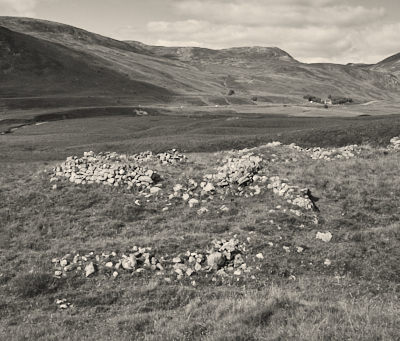
 For years I’ve driven past the archaeology on the west hillside of Gleann Beag but never ventured across to the very obvious ruins. Mainly as a reasonable river (Allt á Ghlinne Bhig) inhibits the way with no bridge, only fording spots.
With so little rain recently it was thought that the river would be easy to cross and so it was though somewhat wet feet were acquired on the return. Wellies next time.
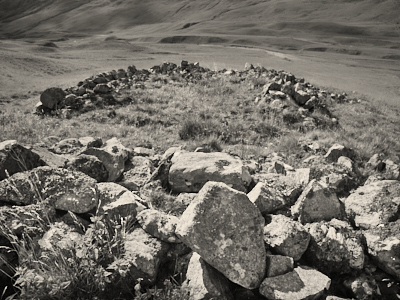
Along the hillside are four equally spaced farmsteads with another slightly further north. The first destination was the farmstead called Croinhedie (Roy Higlands, 1747 -52), Cronachoryy (Aaron Arrowsmith, 1807), Crò na h-Airidh (OS Six inch, 1840s-1880s), Cronaherie (Rev. T.D. Miller 1929), Cro Na H-airighe (HES Trove). I’m sticking with Crò na h-Airighe as per recent OS map. How names change with different spelling over time, though rooted to an original.
Trove requires confusingly it’s own exact spelling if doing a name search but to save you the mess that is Trove here is the Link to the information that covers the archaeology rather well and also quotes from the book by Rev. T.D. Miller (formerly minister at Glenshee), Tales of a Highland Parish (Glenshee) 2nd ed.1929. Worth seeking out.
Oddly Crò na h-Airidh is not next to the water course called Allt Crò na h-Airidhe which the next farmstead along is but actually next to Allt Creag Dubhaidh.

The Ramsey family who were the tenants for decades up until they eventually abandoned their farm and home in 1812. The other tenant farmers in the glen also abandoned what had been their life, work and history. Many emigrated to the colonies were some prospered, if not all. It appears this was not a forced eviction but one of mutual consent, sad time nonetheless.
However, at an altitude of 1509 ft to eke out a living as they amazingly did for decades and in some form probably for centuries was inevitably going to end. Land ownership, agricultural change and the change in society in general. Now only an estate house and units remain at Rhiedorrach across the glen. So in a way life still goes on, if only one family and the workers when needed travelling from further afield by car.
Even though a lot of their livestock, that which the land could sustain, would have been moved south during the winter months, in part the Winter weather but also the issue as in other parts of Scotland of an insufficient supply of feed. Much of the livestock will have been very malnourished come the Spring, those that survived when there was little to nothing to eat over previous months. The weather itself could and did take the lives of many an animal as Rev Miller relates, one farmer in Gleann Beag in the late 19th century lost five hundred sheep and five horses during one particular snowstorm.
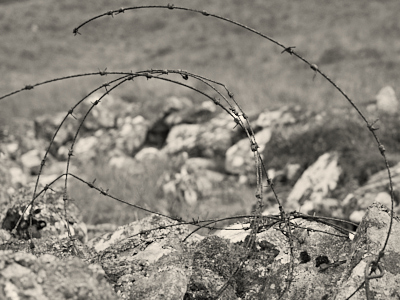 The balance the farmers of Gleann Beag must had to deal with is difficult to imagine but they would have had livestock as well as crops to manage, good years and bad. Rain, snow and sunshine, quite possibly all in one day. Systems of management will have developed over centuries, adapting as needs must.
Crops were grown as it is easy to spot the ridge furrows leading down from the farms and enclosures. These will have required plentiful manure from livestock to act as fertiliser as well as lime though the soil in the glen is relatively lime rich and there is a good source apparently on the Cairnwell. Corn and lime kilns can be found at the various farms.
The next farmstead visited was just due south and called Lag nan Cnàimhean (OS Six inch, 1840s-1880s), Lag Nan Cnaimbean (HES Trove, a ‘b’ for an ‘h’), and Laganagriene (the hollow of the bones) (Rev. T.D. Miller 1929). The map in Millers book spells it Lagnagrain. Again here is a Link to the description of this well recorded site Link.
This farmstead is as interesting as Crò na h-Airidh and if you are into drying kilns there is a rather nice example. Grain drying kilns will have been an essential fixture for such a location.
All worth a visit and still plenty to explore. For my next visit I’m keen to see Gorrowmill, Garrow Hill, Gormel, (I despair) that is further to the north and was abandoned in the early 18th century following an avalanche. The occupants managing to survive but obviously enough was enough and moved away.
There also several sites to see further south. Then you have the settlement/farmstead sites on the west side of the glen that include a couple of nice standing stones. A picture of the stones can be found here Link and a link to a zoomy panorama of the area I’ve now managed to walk over.
There are some shieling type bothies on both sides but non were located on this occasion though there was a very nice enclosure spotted on the hillside well above the farmstead and another later noted further along (56.84316° N, 3.42104° W and 56.83688° N, 3.42207° W).
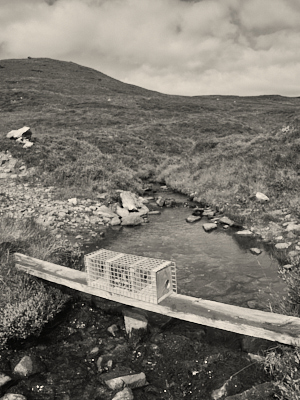
The area and indeed most of Gleann Beag is geared up for serious sporting activities; grouse and deer. Lots of shooting butts and bird feed/grit mounds as well as traps for ‘predators’. On our visit three large herds of red deer were spotted plus one barking roe deer.
How this will settle with those walking the hills I don’t know. It won’t be stopping me if there are no clear indications shooting is in progress, as there should be and I have no objection to that and would take heed.
Take your wellies and cross the river; explore and let your imagination place yourself living a few centuries back and in the landscape that is Gleann Beag.
I've added a small gallery of images from the visit that can be viewed here: Link